If you’ve ever sat down for a casual mahjong game with friends at a community center or a friend’s game night, you’ve probably noticed how automatic mahjong tables change the rhythm of the experience. No more fumbling with tiles to sort them between rounds, no more arguing over missing tiles mid-game—these tables streamline the process, letting players focus on strategy and conversation instead of logistics. But as a supplier of these tables, I get one question more than any other, from casual players and game venue owners alike: Can automatic mahjong tables be customized? Automatic Mahjong Table

The short answer is yes, but the “how” and “what you can customize” depends on a mix of industry standards, manufacturing capabilities, and what end users actually need. Over the 12 years I’ve been in this business, I’ve worked with everything from a small café owner in Tokyo who wanted tables that matched their café’s minimalist wood finish, to a high-end mahjong lounge in Macau that needed custom tile return speeds for professional tournaments. These experiences have taught me that customization isn’t just about aesthetics—it’s about solving specific, real problems for each client.
First, let’s break down the basics of how automatic mahjong tables work, because that’s key to understanding what can and can’t be changed. Most standard models have a central mechanism that draws tiles from the table’s edges, shuffles them in a hidden chamber, and returns them to players in neat walls. The core components—the shuffle motor, tile sensors, and return arms—are standardized across mass-produced models to keep costs low and repairs simple. But everything from the tabletop material to the control panel’s interface can be tweaked, as long as it doesn’t interfere with those core functions.
A common misconception is that customization is only cosmetic, but functional customization is where most of my clients find the most value. For example, small game halls that host 4-player mahjong (the most common format) often have low ceilings, so they need compact tile stacks that don’t rise as high as standard 14-tile walls. I recently worked with a venue in Singapore that wanted tables tailored for a popular 3-player mahjong variant, which means the tile return system has to adjust to a smaller, asymmetrical wall layout. That required re-calibrating the table’s sensor system to recognize the different tile patterns used for 3-player play, a tweak that took our engineering team two weeks to perfect but made the tables feel built just for their games.
Then there’s the aesthetic side, which ranges from subtle adjustments to bold, statement designs. Standard tables usually come in either dark wood or black plastic finishes, but I’ve had clients request everything from marble tabletops for high-end lounges to waterproof table surfaces for outdoor mahjong events (yes, outdoor mahjong is a thing in tropical Southeast Asia). One of my favorite projects was with a retro game café in Seoul that wanted tables with a vintage 1960s diner vibe—we swapped the standard control panels for chrome-plated buttons and added LED lighting around the table’s edge that glowed warm amber, matching the café’s decor. The key here is that cosmetic changes almost never affect functionality, as long as we test the table after modifying the surface to make sure tiles still slide smoothly and the shuffle mechanism isn’t blocked.
But customization has limits, and it’s important to be transparent about that. For example, you can’t change the table’s size beyond a certain point without compromising the tile return system. Automatic mahjong tables are built to fit standard tile sets, which are 1 inch per tile, so if someone tries to make a table too small, there’s not enough space for the shuffle chamber. Similarly, if a venue wants to use non-standard tiles—like oversized decorative tiles for display purposes, instead of play tiles—we have to adjust the sensor settings to recognize the tile’s weight and size, which is a more involved process. That’s why I always start consultations by asking clients to share their specific use case: is this table for casual home use, a professional tournament, or a small business space? The answer shapes every part of the customization process.
Another big area of customization is the user interface, especially for clients who aren’t familiar with automatic tables. A lot of elderly players, for example, struggle with standard control panels that have 10+ buttons for “shuffle,” “wall setup,” and “tile discard.” Last year, I worked with a senior community center in Taiwan that wanted tables with simplified panels—just three large buttons: one to start a game, one to pause between rounds, and a reset button. We also added audio prompts in Mandarin that announced when the walls were ready and when a player’s turn was up, which made the tables accessible to members who might have trouble reading small text. For professional tournament organizers, on the other hand, we added advanced settings that let them adjust the shuffle speed, track tile counts, and even block certain tile combinations for competitive play.
I’ve also seen how customization can build brand identity for businesses. Mahjong lounges are popping up all over major cities, and many want tables that stand out from competitors. A friend who runs a lounge in Shanghai recently asked for tables with custom engraving on the table’s center—small, subtle logos that blended with the wood finish, so when players looked up at the central light, they saw the lounge’s name. That small touch made the lounge feel more cohesive, and regulars often comment on how it feels like a space built just for them. For online mahjong platforms that also rent physical tables for pop-up events, we’ve even added small tablet holders in the table’s edge, so players can pull up digital leaderboards or live game streams mid-session.
Of course, custom tables aren’t for everyone. If a casual buyer just wants a table for occasional home games, a standard model will work perfectly—it’s cheaper, easier to repair, and has all the functions most people need. But for businesses, or for people who want a table that fits their specific lifestyle, customization is worth the extra cost and lead time. On average, a custom table takes 4 to 6 weeks to build, compared to 1 to 2 weeks for a standard model, and costs 15 to 25% more. But for a venue that sees 100+ players a day, or a homeowner who loves hosting mahjong parties, that investment pays off in long-term satisfaction.
One of the biggest mistakes new clients make is assuming that customization means changing every part of the table. But in reality, most of the time, it’s just small, targeted changes. Last quarter, a café owner in Bangkok wanted tables for their outdoor seating area, where humidity and occasional rain are issues. We didn’t rebuild the entire table—we just switched the tabletop to a waterproof, scratch-resistant composite, added a drip tray around the edge to catch moisture, and adjusted the motor to be slightly more power-efficient to handle the heat. That small customization made the tables usable year-round, instead of only during dry seasons.
As a supplier, I also prioritize making sure custom tables are easy to repair, just like standard models. No one wants a custom table that can’t be fixed if a part breaks. That’s why all the custom components we use are compatible with standard replacement parts—if a control panel button breaks, you can order a generic replacement instead of having to wait for a custom part to be made. That’s a key point I always emphasize to clients: customization should enhance, not complicate, the table’s usability.
Looking ahead, I see more demand for customization as mahjong continues to grow in popularity beyond its traditional markets. We’re already working with clients in Europe and the Middle East, where mahjong is a newer game, and they want tables that fit their cultural preferences—like smaller tile sets for tables that fit in European-style apartments, or control interfaces in local languages. I expect that in the next few years, we’ll also see more demand for smart custom features, like integration with phone apps that track game stats or let players join online tournaments directly from the table.
At the end of the day, the question isn’t just “Can automatic mahjong tables be customized?” It’s “How can we customize them to fit what you need?” Every client has a unique situation—whether it’s a small home game, a busy business, or a tournament venue—and customization lets us build a table that works for that situation, instead of forcing you to adapt to a one-size-fits-all model.
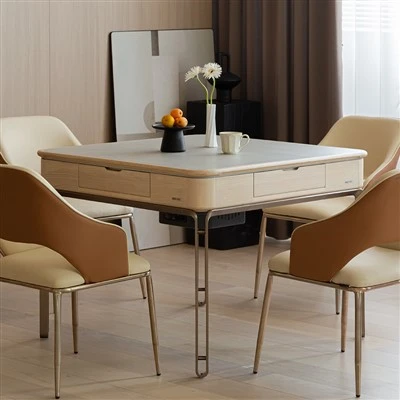
If you’re thinking about a custom automatic mahjong table for your home, business, or special event, reach out to us to discuss your needs. We’ll walk you through the options, from cosmetic tweaks to functional adjustments, and make sure the final table is exactly what you’re looking for, without the hassle of complicated repairs or incompatible parts.
Wooden Frame Automatic Mahjong Table References:
Mahjong Table Industry Manufacturing Standards, 2023, Global Gaming Equipment Association
Customization in Gaming Table Design, 2022, International Journal of Leisure and Hospitality Technology
Automatic Tile Sorting Mechanisms: Functional Limits and Adaptations, 2021, Journal of Gaming and Amusement Industry
Matsuoka Technology (Zhejiang) Co., Ltd.
Matsuoka Technology (Zhejiang) Co., Ltd. is one of the most professional automatic mahjong table manufacturers and suppliers in China, featured by quality products and good service. Please rest assured to wholesale bulk cheap automatic mahjong table from our factory. Welcome to view our website for more company information.
Address: No.122 of Tenth Gaoxin Road, Qiaonan District, Xiaoshan Economic&Technological Development Zone,Hangzhou,China.
E-mail: niuhua@treyo.net
WebSite: https://www.treyo-mahjongtables.com/
