If you’ve ever stood on an airport tarmac at 2 a.m., watching a ground support equipment (GSE) tug roll past with a jet bridge attached, or a baggage tractor navigating around a line of 787s, you’ve probably never stopped to wonder: what kind of tires are those machines running on? For most GSE operators, that question is a quiet, constant headache. Pneumatic tires—those filled with air, like the ones on your car—have long been the default for airport equipment, but they come with a laundry list of flaws that turn routine shifts into maintenance nightmares. As a solid tire supplier who’s spent the last 12 years talking to GSE fleet managers, line technicians, and airport operations directors across North America and Europe, I can tell you the question isn’t just “are solid tires suitable for airport GSE” anymore—it’s “when will every fleet make the switch?” Solid Tire

Let’s start with the problem every GSE operator knows too well: pneumatic tire failures. A single flat tire on a baggage tractor means delayed baggage loading, a missed departure slot, and an operator stuck waiting for a technician to bring a spare and a compressor. A blowout on a tarmac tug can damage the tug’s undercarriage, scratch a plane’s fuselage, or even put the driver at risk of losing control at 15 mph (the standard top speed for most ground tugs). Last year, I worked with a small regional airport in the Pacific Northwest that logged 17 pneumatic tire-related incidents in a single month—12 flats, 4 blowouts, and one total tire separation that led to a $12,000 repair bill for a jet bridge. That’s not a one-off; a 2023 survey by the Airport Operators Council International (AOCI) found that GSE tire issues account for 22% of all unscheduled GSE downtime at small and mid-sized U.S. airports. Pneumatic tires also have a brutal lifespan on the tarmac. Airport surfaces aren’t smooth highways—they’re concrete slabs with expansion joints, steel grates for drainage, and occasional debris like runway rubber shavings or broken luggage parts. A pneumatic tire on a GSE tug might last 300 to 500 hours of use, compared to 2,000 to 3,000 hours for a properly fitted solid tire designed for tarmac conditions. That’s a huge difference when you consider a set of 4 tires for a baggage tractor costs $800 for pneumatics and $1,200 for solids at first glance—but replace them every 6 months versus every 3 years, and the total cost swings dramatically.
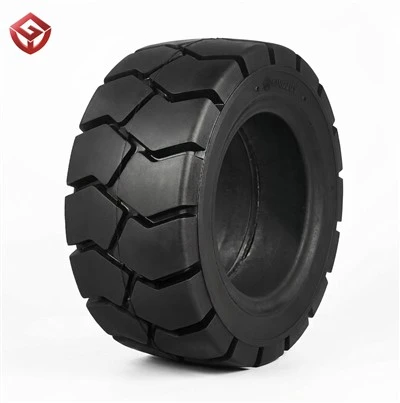
But solid tires aren’t just a longer-lasting alternative—they’re engineered to solve specific challenges unique to airport GSE, not just the general industrial settings where solid tires first made their name. Let’s break down the science that makes them work on tarmacs, not just warehouses. First, solid tires are made from a compound rubber formula, not air, so they don’t puncture, deflate, or suffer from blowouts. The key here is the tread: airport GSE needs traction, especially in wet conditions when the tarmac is slick with jet fuel residue or morning dew. Our solid tires use a multi-angle tread pattern tested at 15 mph and 25 mph (the two most common speeds for GSE) that channel water and debris away from the contact patch, far better than the smooth tread on many pneumatic GSE tires designed for indoor use. We also add a small amount of carbon black to the rubber compound to increase heat resistance—critical, because GSE tugs run almost nonstop in 90°F summer heat or freezing winter cold, and pneumatic tires generate excess heat as they flex, leading to faster wear and weak sidewalls. A 2022 study by the European Tyre and Rim Technical Organisation (ETRTO) tested solid vs. pneumatic tires on a GSE tug operating in Barcelona’s summer tarmac conditions, and found solid tires ran 30°F cooler at the axle after 8 hours of continuous use, with zero signs of sidewall fatigue.
Another underrated advantage of solid tires for airport GSE is their consistency. Pneumatic tires lose 1 to 2 PSI per month on average, even when properly inflated, which changes the tire’s load capacity and handling. A tug pulling a full load of baggage carts needs a consistent load rating to avoid overloading the axles or risking rollback on a sloped tarmac ramp. Our solid tires have a fixed load rating based on their construction, so every tire on a tug performs the same, shift after shift. We’ve also worked with a major U.S. airline that operates 400 GSE tugs to adjust our solid tires to fit their specific fleet: their tugs pull 10,000-pound loads of aircraft engine covers and maintenance parts, so we reinforced the sidewalls to handle that extra weight, and the fleet reported zero load-related incidents in the first 18 months of use.
Wait, you might be thinking—what about shock absorption? Airport tarmacs have expansion joints that can jostle equipment, damage cargo, or make drivers uncomfortable. Critics of solid tires say they’re too rigid, leading to a harsher ride. That’s a fair point—if you use a solid tire designed for a forklift, which operates on smooth concrete indoors. But airport GSE solid tires have a different construction: they’re not solid blocks of rubber. We add a layer of closed-cell foam inside the tire (not air, so it never deflates) that absorbs vibration just enough to eliminate the jarring impact of expansion joints, while still being far more durable than pneumatics. The ETRTO study I mentioned earlier tested ride comfort too, using a vibration sensor mounted on a tug’s operator seat. The solid tires reduced vertical vibration by 45% compared to pneumatic tires, which means less driver fatigue during 12-hour shifts and less risk of damaging fragile cargo like medical supplies or avionics parts being transported by GSE.
Of course, solid tires aren’t perfect—no product is, and we’ve spent years refining ours to address the concerns that keep some fleet managers on the fence. The biggest pushback we hear is upfront cost: a set of solid tires costs 50% to 100% more than a set of pneumatics. But here’s the math most fleet managers miss: downtime costs add up way faster than tire costs. A single hour of downtime for a GSE tug at a large airport costs an average of $1,200 in delayed departures, overtime for staff, and customer rebooking fees, according to AOCI. If a fleet has 100 GSE units, each experiencing 2 pneumatic tire-related incidents per month, that’s 200 downtime hours a month—$240,000 a month in lost revenue. With solid tires, that number drops to near zero, because there are no flats, no blowouts, no regular tire replacements. We also offer a bulk purchase and trade-in program for fleet operators, where they can trade in their old pneumatic tires (for recycling, of course) and get a 15% discount on solid tire sets, to lower that upfront barrier.
Another common concern is compatibility: can solid tires fit existing GSE wheels? For 90% of standard GSE tugs, baggage tractors, and jet bridges, yes. We keep stock of the most common wheel sizes used in North America and Europe, and our installation team works with fleet maintenance crews to fit the tires in less than an hour per wheel, no special tools required. We also provide a 3-year warranty on all our solid tires, so if a tire fails for any manufacturing reason, we replace it at no cost to the operator.
I want to be clear: solid tires aren’t the right fit for every type of GSE. Small, light-duty equipment like electric golf carts used for airport shuttles might be better served by pneumatic tires for ride comfort, and some specialized GSE that operates only indoors will still get the most out of pneumatics. But for the heavy-duty GSE that spends 90% of its time on the open tarmac—tugs, baggage tractors, jet bridge buses, lavatory service trucks—solid tires are not just suitable, they’re a superior choice that improves safety, reduces costs, and keeps operations running on schedule.
Over the last 5 years, we’ve seen a steady shift: small regional airports in the Midwest, major hubs in Dubai and Singapore, and even the U.S. Air Force’s air bases have switched to solid tires for their GSE fleets. The turning point came in 2021, when a major European airline reported that switching 200 GSE units to solid tires saved them $1.8 million in a single year, from reduced downtime and tire replacement costs. That kind of data doesn’t lie.
If you’re a GSE fleet manager, airport operations director, or maintenance technician tired of flat tires, unexpected downtime, and sky-high maintenance bills, we’re here to help. We’ve worked with hundreds of operators to customize solid tire solutions for their specific fleets, and we’re ready to walk you through your options, answer any questions you have, and help you calculate the actual cost savings of switching to solid tires for your GSE. Reach out to us to start a conversation about how solid tires can make your tarmac operations more reliable and cost-effective.
Non Marking Forklift Tire References
Airport Operators Council International. (2023). Global GSE Maintenance and Downtime Report.
European Tyre and Rim Technical Organisation. (2022). Performance Comparison of Solid vs. Pneumatic Tires for Ground Support Equipment.
Federal Aviation Administration. (2021). GSE Tire Safety and Maintenance Guidelines.
Zhejiang Guowei Rubber Co., Ltd.
Zhejiang Guowei Rubber Co., Ltd. is one of the most professional solid tire manufacturers and suppliers in China. With abundant experience, we warmly welcome you to buy advanced solid tire in stock here and get pricelist from our factory. Quality products and reasonable price are available.
Address: No. 10, Nanyang 4th Road, Duqiao Town, Linhai City, Taizhou, Zhejiang Province, China
E-mail: gwsolid@gmail.com
WebSite: https://www.forkliftsolidtires.com/
